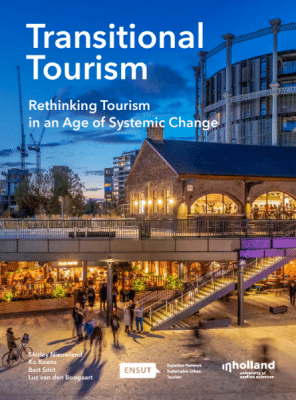
Sustainable tourism, the circular economy, regenerative tourism, degrowth, and doughnut economics—in recent years, numerous concepts have been introduced to make tourism future-proof. But what do these terms actually mean? How do they differ from one another? And how can they contribute to genuine transformation in practice?
These questions were explored over the past year through the project “Transitional Tourism: Rethinking Tourism in an Age of Systemic Change”, led by Ko Koens, Professor of New Urban Tourism, in collaboration with Paradise Found and Ginder. The final report provides, for the first time, a clear overview of the various perspectives on tourism transition. Not to introduce yet another buzzword, but to reveal the underlying processes and choices necessary for structural change in tourism.
Traditional Sustainability
To understand where all these new concepts come from, it is useful to briefly look back. The triple bottom line approach—people, planet, profit—was originally intended as a catalyst for systemic change. However, it quickly became reduced to a balancing exercise in which economic growth almost always prevailed. Profits were allowed to offset costs to people and nature, as long as some form of “balance” could be demonstrated. What began as a radical way of thinking became little more than a reporting framework.
“This has led to a growing demand for concepts that go beyond traditional sustainability, such as regenerative tourism and degrowth, but also approaches that strengthen broad prosperity or circularity through tourism,” explains Ko. “There are now so many of these concepts that it has become difficult to see the forest for the trees.” The research report seeks to provide clarity by comparing eight different approaches.
Transition as Systemic Change
The report identifies eight transitional approaches: the Sustainable Development Goals (SDGs), broad prosperity (well-being), equitable tourism, circular tourism, degrowth, regenerative tourism, destination stewardship, and doughnut economics. These approaches share an overarching vision: transitional tourism.
Transitional tourism is not about optimizing the current system but about replacing a dominant, unsustainable worldview with a new one. It requires rethinking the system itself—its governance structures, market mechanisms, consumption patterns, and assumptions about growth.
Six core elements define this transitional perspective:
- Reconsidering the role of economic growth and no longer treating it as a given.
- Viewing tourism as part of a complex, living system that interacts with nature and society.
- Adopting an ecocentric perspective in which nature has intrinsic value beyond economic utility.
- Taking a place-based approach that starts from the needs of local communities.
- Emphasizing co-creation by actively involving residents and stakeholders as a foundation for decision-making.
- Translating ambitions into concrete action supported by appropriate measurement tools.
“The danger is that these terms lead to transition-washing. Transition concepts are used to rebrand existing policies without changing the underlying logic.”
Ko Koens, Professor of New Urban Tourism at Inholland University of Applied Sciences
Eight Approaches, One Movement
The eight approaches vary in their degree of radicalism. The SDGs and broad prosperity largely operate within the existing growth paradigm and are therefore more accessible in practice. Regenerative tourism, degrowth, and doughnut economics fundamentally challenge the foundations of that paradigm, but for that very reason are more difficult to implement.
Using the Three Horizons Framework, the report demonstrates that these approaches should not be viewed as competing alternatives but rather as complementary elements within a gradual transition process.
Each approach has its own strengths and weaknesses, depending on context, scale, and political realities. Consequently, the researchers advocate “strategic pluralism”: a deliberate combination of approaches tailored to the specific challenge and stage of transition. A destination that is only beginning to question growth indicators requires a different starting point than a city struggling with overtourism.
Practice Is Lagging Behind
A striking gap exists between theory and practice. In the European cities studied, terms such as regenerative tourism and degrowth are frequently used, but the underlying strategies often remain conventional: improving visitor dispersal, attracting “higher-quality tourists,” or increasing tourist taxes.
Fundamental questions—Do we actually want more tourists? Does tourism belong here at all?—are rarely asked.
“The danger is that these concepts result in transition-washing,” Ko warns. “Transition terminology is used to give existing policies a new appearance without changing the underlying logic.”
A second challenge concerns measurement. Key performance indicators (KPIs) continue to focus on visitor numbers, spending, and overnight stays. Well-being, social cohesion, and ecological carrying capacity are softer values that are difficult to quantify and therefore often remain invisible.
The researchers propose reflexive monitoring as an alternative: a cyclical learning process in which quantitative data and qualitative insights are jointly discussed by all stakeholders. Rather than serving as an external control mechanism, monitoring becomes an integral part of the transformation process itself.
Now Is the Time
The good news is that change is underway. Increasingly, destinations recognize that tourism is more than an economic engine. Residents matter. Growth is no longer sacred. The central question is shifting from how much to for whom and for what purpose.
But recognition alone does not constitute a transition.
The researchers recommend moving beyond debates about which approach is best. Instead, destinations should analyze their own context, select an approach that fits their circumstances, develop concrete actions, establish a monitoring process, and engage stakeholders throughout the journey.
As Ko concludes:
“The terminology matters less than whether real change is taking place. And that requires courage—from politicians, policymakers, destination management organizations, entrepreneurs, and researchers alike. Making tourism transitional is not merely a strategic choice. It is a societal responsibility.”